Panasonic Lumix DMC-GH4 Hands-on Review.
The friendly waiter at the Turkish restaurant in Sohar, Oman, saw the camera on the table and asked “Nikon? Canon? Which one is better?” To which I replied, “actually, this is a Panasonic GH3.” He stared at me, and his expression turned from excited to perplexed to confused to annoyed within seconds. After an uncomfortable silence he finally asked, “Are you ready to order?”
That was pretty much my reaction when, only two days before I started teaching a workshop in Dubai, I found out that Panasonic, a major sponsor of the event, REALLY wanted me and my students to shoot with a couple of pre-release GH3s.
The rest of the story (which has a happy ending, thanks for asking) can be read here: http://bit.ly/GH3_FieldReport.
Very recently I was invited to field test Panasonic’s latest and—judging by the reaction of the media and the traffic in my inbox—hottest product, the GH4. With only three cameras available worldwide at the time, I considered it a great honor.
So, what’s the big deal?
By now all of you know that this year’s flavor is 4K, from action/sports cameras like Sony’s HDR-AS100V to Canon’s 4K monitors to 120-inch 4K TV sets for less than $1,000. Netflix and YouTube joined the party announcing 4K streaming that requires less bandwidth, and even Asus released a $180 Chromebox that can output 4K!
What the GH4 is accomplishing is two-fold: it is offering 4K resolution for under $2,000 (the exact price is yet to be announced), effectively bringing 4K to the masses, and it is developing a tremendous downward price pressure for competitors. We have already witnessed Blackmagic reducing the price of its brand-new 4K system by 25%. And I believe this is only the beginning.
With extremely limited time to play with the GH4, multiple assignments already in place, and a nasty winter in New York, my partner on this project, Sean Davis, and I focused on a few key questions:

Eduardo Angel with Camera
1. Will our current workflow, which includes Adobe Creative Cloud, Canon products (ranging from the 60D to the 5D Mark III to the C300 and even some 1DCs), a couple of GH3s, and Blackmagic’s Pocket Cinema Camera work the same, or would it need to be adapted to the needs of the GH4?
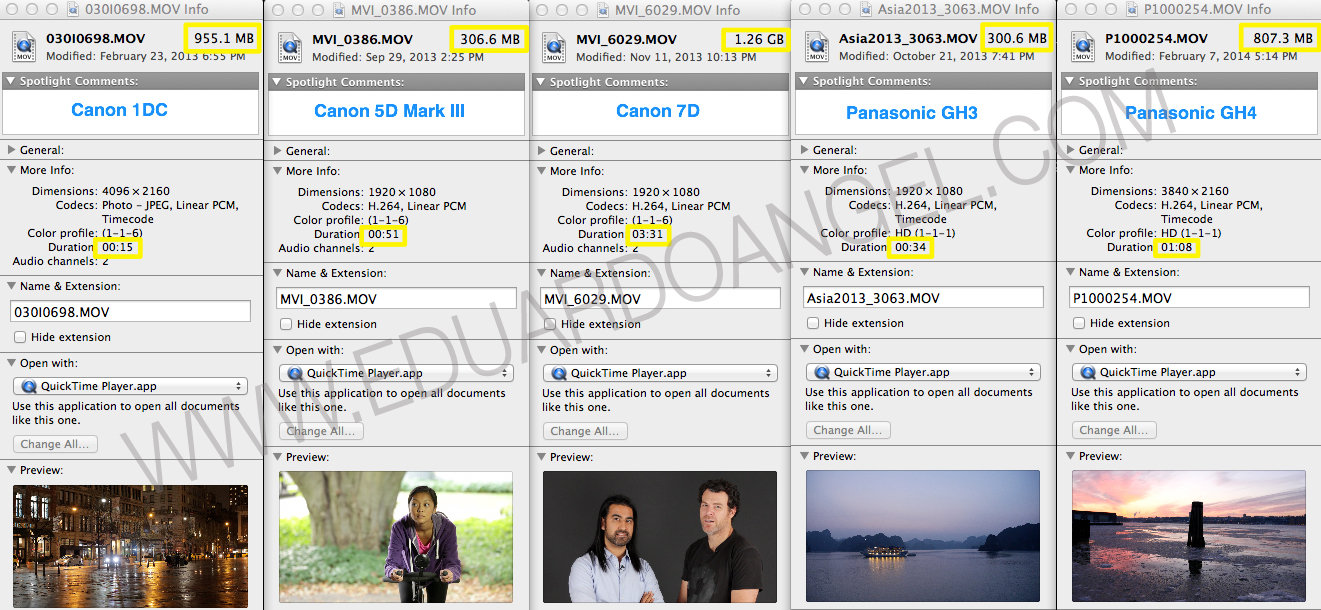
File Sizes for different cameras shows the 4K of the GH4 is quite competitive vs. lower res video of others
Results: No problems. Everything remains the same. We downloaded the cards directly to a G-Tech Thunderbolt External Drive connected to a 27-inch mid-2011 iMac, and opened the MOV directly into Adobe Premiere Pro CC v7.2.1 without transcoding to ProRes or doing anything special to the files.
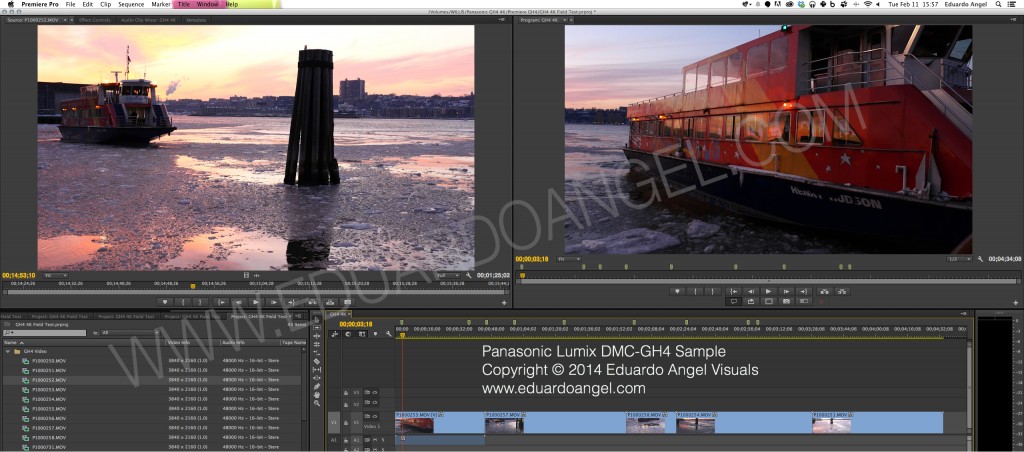
Everything works great in Premiere Pro!
2. Will our current accessories, including power-rigging toys, memory cards, etc., remain the same or do we need to set aside a new “GH4 accessories budget”?
Results: Bittersweet. The GH4 and GH3 share the same exact DMW-BLF19 battery, so all our “power rigging accessories” will continue to work. But, the GH4 didn’t like the SanDisk 95mbs SDXC that we always use with our Blackmagic Pocket Cinema Camera. We ended up using a beta SDHC II 280mbs 32GB card provided by SanDisk, which in combination with a pre-production camera running firmware v0.3 and temperatures in the lower 20s turned the test into a real challenge.
What is clear is that we will need faster and perhaps bigger cards. Shooting 4K @100mb/s 30p on a 64GB card will give you about 29 minutes of shooting time.
3. Besides 4K, are there other significant improvements that justify buying a GH4 as opposed to renting one?
Results: With newly added features like peaking, Cinema-like gamma, HDMI with 4:2:2 8/10 bit output, a new Digital Live MOS sensor, twice the readout speed, faster contrast-detect AF, and cleaner files at high ISOs, our verdict is simple: buy it!
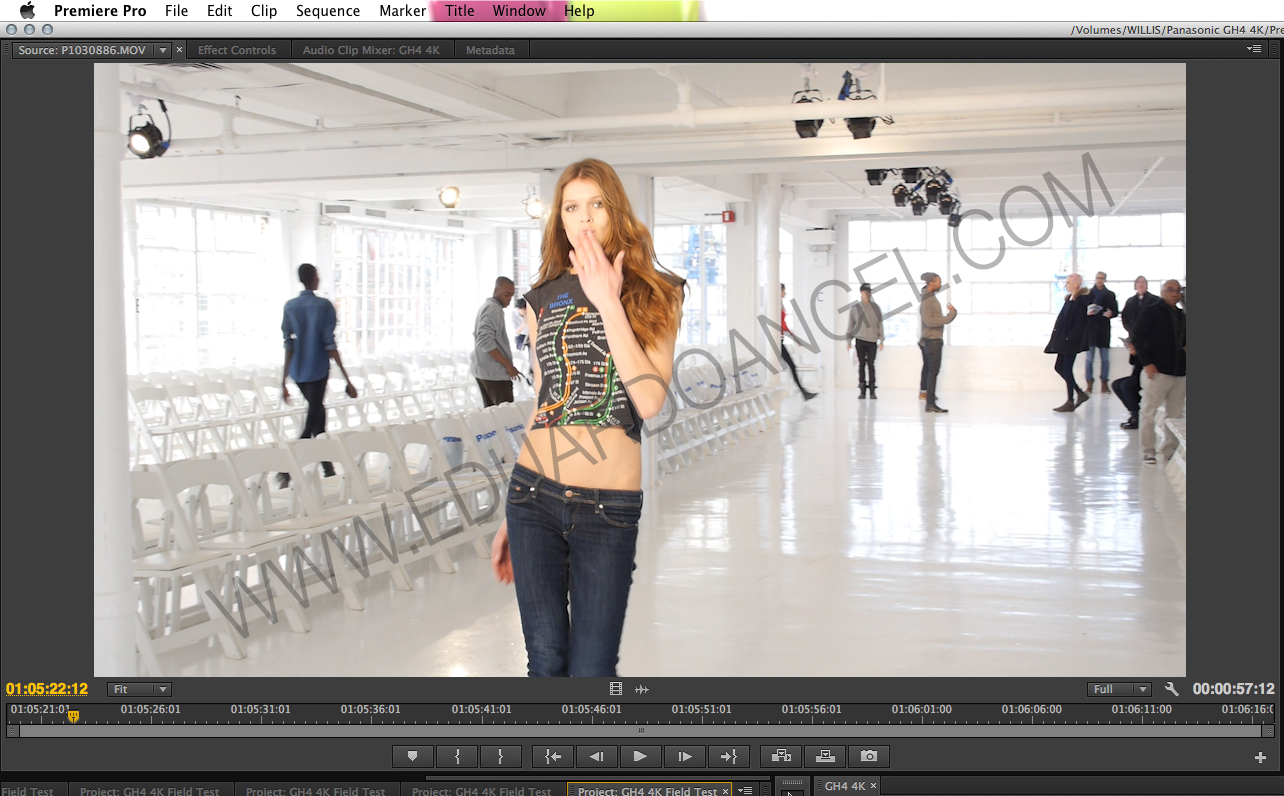
To learn more about the GH4’s specs please visit http://bit.ly/PanasonicGH4. To read about other interesting things we discovered during our field test, visit http://bit.ly/GH4FieldTest.
Eduardo Angel is an independent technology consultant, educator, and visual storyteller based in Brooklyn, New York. His mission is to inspire and empower photographers, filmmakers, and corporations in the use of technology to enhance creativity.
Eduardo is a faculty member at the School of Visual Arts and the International Center of Photography in New York. He is a member of Tenba’s Visual Artists and X-Rite’s Coloratti programs, and he has worked as an Adobe official beta tester for Lightroom and Premiere Pro.
Eduardo regularly speaks at conferences and industry events, distinguished photo workshops, and educational institutions around the world. Selected consulting clients include Adobe, Canon U.S.A., Fashion Institute of Technology, New York magazine, NAB Show, the New York Times, Sony, Tenba, Time Inc. Digital, and X-Rite, among others.
Eduardo regularly publishes his thoughts on photography, filmmaking, and technology on his blog www.eduardoangel.com.